 Color Theory Introduction
Colors of the Rainbow
Color Vision
Color Properties / Terminology
Color Luminance
The Color Wheel
Color Names
 Example color names:
Colors with name have the advantage of carrying meaning
which can be helpful for choosing good colors. The meaning is probably
shared by people speaking or knowing the same language because
color names are tied to language boundaries. Of course, this
can be an advantage and a disadvantage at the same time. Knowing
colors by name also helps building up the set of colors one is
conscious to. On average people can tell ten to twenty colors
spontaneously. Growing that list to about 50 to 300 makes using
color more intuitively.
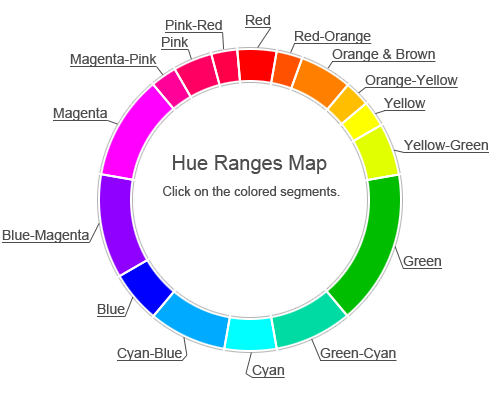
For a one-page overview we prepared a full
But wait, you might find it more useful to browse
How to use
Please use the HEX, RGB or HSL values of the colors as
HTML color code or CSS color code. For documents / applications
the quickest way to use a certain color is to copy its HEX
value and paste it into a designated input field.
If you like a color but want to tweak its properties you can take
it over to the HSL Color Picker. Watch out for the link...
The color pages contain several color properties like
RGB, HEX and HSL values. This way you should be able to use the colors
for most applications.
The luminance value of the colors allows checking for
appropriate perceived brightness contrast in advance.
Read more about color luminance
here.
Summary
Color names allow us to characterize color in a more natural way compared to properties of color models. This comes in handy for color choosing, color identification and in communication. In practice this compensates for the lack of accuracy of such characterization. Browsing colors by name is a great method to gain inspiration.
